
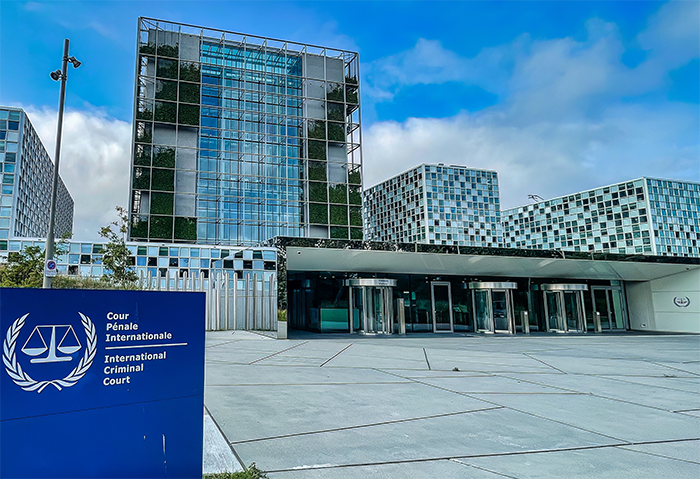
On 1 December 2025, the International Criminal Court’s (ICC) Office of the Prosecutor (OTP) launched its fourth annual report, ‘Resilient Justice In Every Step’. The report, which consists of four chapters, is designed to provide readers with a “holistic view of the Office’s activities on investigation, prosecution and cooperation, including key milestones and initiatives”. The report’s release was accompanied by an official launch event at the Hague that included a Q&A session with Deputy Prosecutor Nazhat Shameem Khan.
Notable courtroom developments
The report noted that over the course of 2025, the OTP was involved in several landmark moments, which include the conclusion of the trials and delivery of justice of:
- The Prosecutor v. Ali Muhammed Ali Abd-Al-Rahman in the Situation in Darfur, Sudan
- The Prosecutor v. Alfred Yekatom and Patrice-Edouard Ngaïssona in the Situation in the Central African Republic II
The report also noted three high-profile developments:
- A confirmation of “charges hearing to proceed in the absence of the suspect in the case of The Prosecutor v. Joseph Kony in the Situation in Uganda”
- A preparation of the confirmation of charges against Mr. Rodrigo Roa Duterte
- The arrest of Mr. Khaled Mohamed Ali El Hishri
Atop these significant developments, the OTP observed, in the period spanning 2023-2025, a significant increase in operational output that resulted in “32 current outstanding warrants of arrest known to the public, including 17 warrants”.
Submissions
The report observed that it had received 83,119 submissions, as well as 571,603 electronic files, through OTPLink, the Office’s official secure evidence submission platform, and noted that this amounts to a daily average of 228 submissions.
Complementarity and the global community
The annual report stated that “2025 marked the first full year of implementation of the Office’s Policy on Complementarity and Cooperation” and provided an update on situation-specific complementarity activities in several jurisdictions, including:
- Afghanistan
- Bangladesh/Myanmar
- Central African Republic
- Colombia
- Darfur, Sudan
- Democratic Republic of Congo
- Guinea
- Libya
- Ukraine
- Venezuela
In each jurisdiction, the OTP regularly cooperated with and/or assisted partners, affiliated organisations, and specific stakeholders.
Cooperation with partners
As part of its mandate, the OTP has continued building out and improving its relationship with “external partners including State authorities and civil society organisations” and highlighted the importance of initiatives such as the OTP Forum on Complementarity and Cooperation and the OTP-CSO Structured Dialogue, with the former operating as a “space for enhanced collaboration with operational national counterparts” and the latter allowing the OTP to meaningfully engage with civil society organisations.
Policy developments
2025 saw the OTP launch two new policies, which the Office noted were the concluding policies in the current policy development cycle that has seen the development of “seven key policy initiatives over the last three years, which helps to respond to modern challenges and better deliver results in the courtroom”:
- Policy on Addressing Environmental Damage Through the Rome Statute
- Policy on Cyber-Enabled Crimes under the Rome Statute
Technology
To continue successfully meeting its mandate, the OTP noted several improvements and upgrades in its technology systems and evidence-processing systems, as overseen by the Office’s Information, Knowledge and Evidence Management Section (IKEMS).
Looking ahead
The OTP’s future work and strategies will be informed by the ICC Strategic Plan 2026-2029, a set of “ten overarching Strategic Goals that will shape the Court’s direction, priorities and performance over the coming years”, alongside its stated goals of increasing “solidarity and dialogue between the Court, States, civil society organisations, affected communities and all stakeholders”, as it seeks to ensure that existing expectations of justice are met.
Key takeaways
The 2025 annual report reveals that the International Criminal Court’s Office of the Prosecutor is fully capable of overcoming any challenges it faces, as evidenced by its continued focus on improving partnerships, policies, and technologies, as well as through the numerous landmark cases and outcomes it achieved over the course of 2025.