
Updating jurisdiction classifications
As reported by AUSTRAC, in October 2025 the FATF published updates on two types of jurisdictions that the organisation monitors:
- High-Risk Jurisdictions Subject to a Call for Action (“Black List”): The FATF provided updates on Iran, the Democratic People’s Republic of Korea (DPRK), and Myanmar.
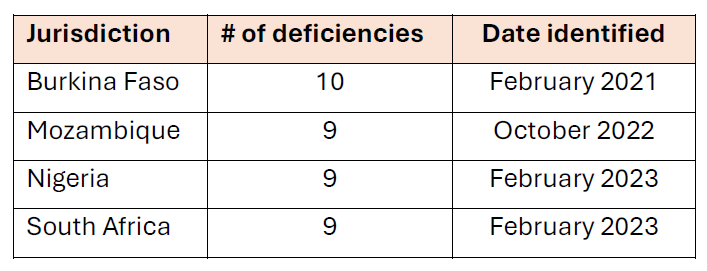
- Jurisdictions Under Increased Monitoring (“Grey List”): The FATF announced that several jurisdictions were no longer subject to increased monitoring as a result of improving their AML/CTF regimes: Burkina Faso, Mozambique, Nigeria, and South Africa.
High risk jurisdictions
Identified as countries with “strategic deficiencies in their regimes to counter money laundering, terrorist financing, and financing of proliferation”, the FATF encourages members and jurisdictions to apply enhanced due diligence and in more serious cases, countermeasures.
In the context of its October 2025 update, the FATF called on members and jurisdictions to apply countermeasures to the DPRK and Iran, whereas for Myanmar it called on members and jurisdictions to apply enhanced due diligence measures proportionate to the risks arising from the jurisdiction.
Democratic People’s Republic of Korea
Due to the DPRK’s poor AML/CTF regime and its creation and financing of weapons of mass destruction, the FATF reminded all countries of the importance of enacting financial sanctions in line with United Nations Security Council’s Resolutions and ensuring the following countermeasures are followed:
- End all correspondent relationships with DPRK banks
- Close all branches or subsidiaries of DPRK banks
- Limit financial transactions and business relations with DPRK persons
Given the DPRK’s continued attempts at integrating itself into the international financial community, the FATF reminded members and jurisdictions of UN Security Council Resolution 2270, which explains that the DPRK has a history of using “front companies, shell companies, joint ventures and complex, opaque ownership structures” to circumvent sanctions, and as such, members and countries should apply enhanced due diligence in relation to any activities involving the DPRK, and to be aware of increased risks of proliferation.
The FATF also noted that given the termination of the 1718 Committee Panel of Experts (following Russia’s veto vote terminating the body) it will continue monitoring compliance and countermeasure implementations against the DPRK.
Iran
In light of Iran’s inability to address the action plan it submitted in 2016, hesitation towards fully agreeing to the United Nations Convention against Transnational Organized Crime (the Palermo Convention), and its domestic Palermo compliance standards not being in alignment with those of the FATF, as well as its continued non-compliance with nuclear non-proliferation obligations, the FATF reminded members and jurisdictions to ensure countermeasures towards Iran were in place, including:
- Not allowing subsidiaries, branches, or representative offices of financial institutions from Iran to be opened or taking into consideration the fact that the financial institute’s country of origin has inadequate AML/CTF systems.
- Not allowing financial institutions to establish branches or representative offices in Iran or taking into consideration that the branch or office would be in a country with inadequate AML/CTF systems.
The FATF has said it will decide on next steps, including suspending countermeasures if Iran completes its action plan and ratifies and implements the Palermo Convention “in line with the FATF standards”. Iran will also remain on the FATF’s black list until its action plan has been fully completed.
Myanmar
Due to a lack of progress in its action plan and general lack of progress, in October 2022 the FATF called on members and other jurisdictions to apply “enhanced due diligence measures proportionate to the risk arising from Myanmar” (and as part of that call, financial institutions should increase their monitoring of business relationships associated with Myanmar and be on alert for unusual or suspicious transactions).
The FATF encourages financial institutions engaging in enhanced due diligence involving Myanmar to be mindful of and permit legitimate transactions associated with humanitarian assistance (particularly in relation to earthquake relief efforts), not for profit organisations, and legitimate remittances. The FATF will also monitor Myanmar’s AML/CTF regime to ensure legitimate financial transactions are not blocked. Myanmar will also remain on the FATF’s list of countries subject to a call for action until such time as it completes its action plan.
Updates to countries subject to increased monitoring
As of October 2025 the FATF removed Burkina Faso, Mozambique, Nigeria, and South Africa from the grey list, as all four countries, as part of their action plans, resolved certain deficiencies that needed to be met to improve their respective AML/CTF regimes.
Key takeaways
By providing information on the status changes to countries across both the black and grey lists, the FATF is able to inform financial service providers and governments as to which regions pose a high risk with regards to money laundering and terrorism financing and proliferation financing, and also remind them of their AML/CTF obligations, thus ensuring they stay in line with international expectations and regulations.